AI Search Is Already Changing Local Customer Behavior
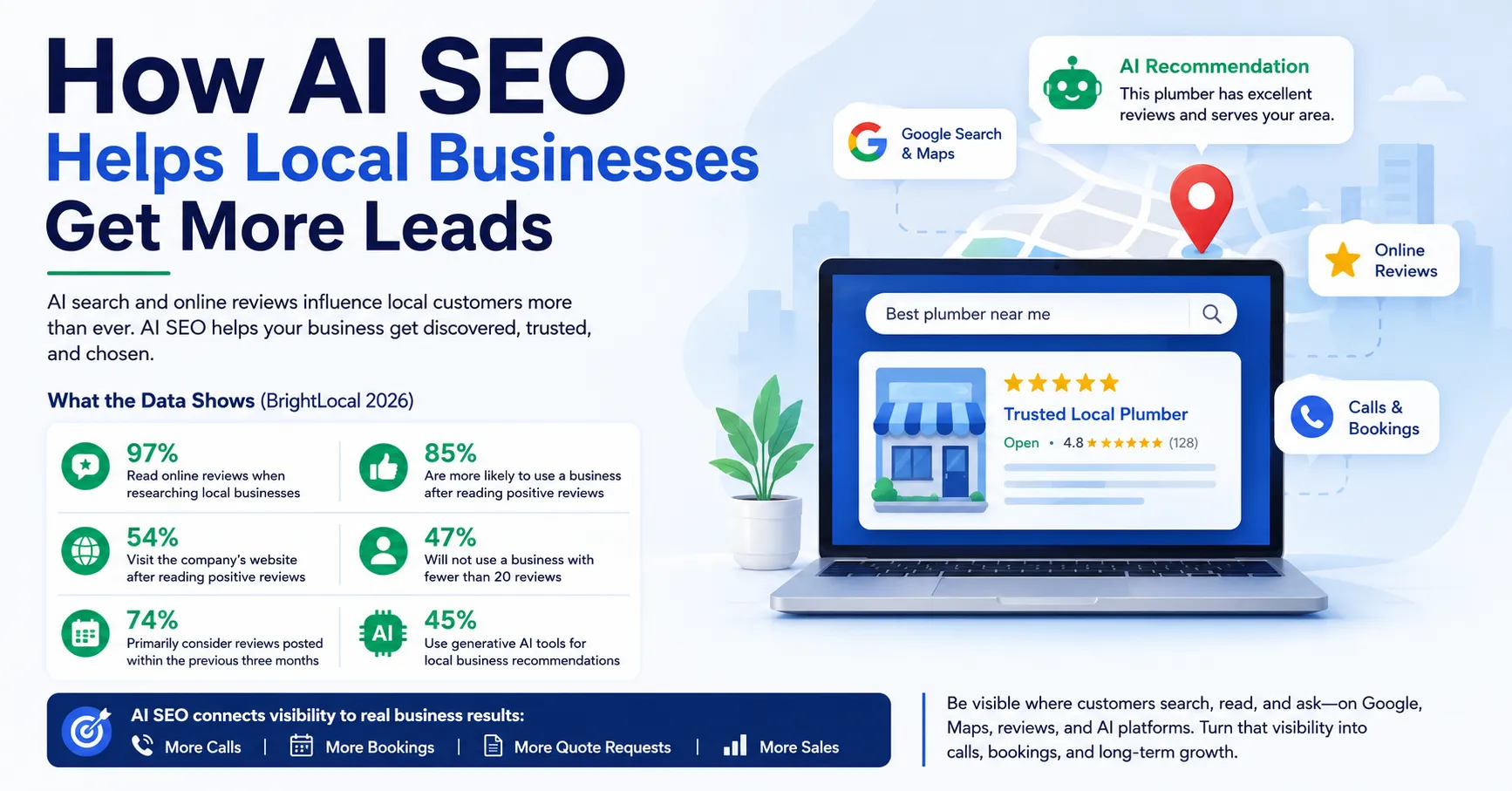
45% of consumers now use ChatGPT and other generative AI tools to find local business recommendations—up from only 6% one year earlier. This rapid increase shows that customers are no longer relying exclusively on traditional Google results when choosing nearby businesses. This is How AI SEO Helps Local Businesses.
The influence of online information goes beyond AI recommendations. BrightLocal’s 2026 consumer survey found that:
| Percentage | What the data shows |
| 97% | Read online reviews when researching local businesses |
| 85% | Are more likely to use a business after reading positive reviews |
| 54% | Visit the company’s website after reading positive reviews |
| 47% | Will not use a business with fewer than 20 reviews |
| 74% | Primarily consider reviews posted within the previous three months |
| 45% | Use generative AI tools for local business recommendations |
These numbers reveal an important change in the local customer journey. People may discover a business through Google, ask an AI platform for recommendations, read reviews, visit the company’s website, and then call or book an appointment.
Google’s search results are changing as well. Pew Research Center found that 58% of the US adults studied performed at least one Google search that generated an AI summary during March 2025. When an AI summary appeared, users clicked a traditional search result during only 8% of visits, compared with 15% of visits when no AI summary appeared. Google has also reported that AI Overviews increased Google usage by more than 10% for the types of searches where those summaries appeared in major markets such as the United States and India.
For local businesses, the message is clear: simply ranking for a few keywords is no longer enough. A business must be visible across Google Search, Google Maps, online reviews, and AI-generated recommendations. It must also provide accurate, trustworthy information that helps potential customers feel confident enough to call, request a quote, or schedule an appointment.
This is where AI SEO becomes valuable
AI SEO helps local businesses organize their website content, reviews, listings, and authority signals so search engines and AI platforms can better understand:
- What the business offers
- Where it operates
- Which customers does it serve
- Why people trust it
- When should someone contact it
The objective is not only to generate more website traffic. The real objective is to attract relevant local customers and convert that visibility into calls, bookings, quote requests, and sales.
What Is AI SEO?
AI SEO is the process of improving a website and its wider online presence so that it can be discovered through both traditional search results and AI-generated answers.
It combines familiar local SEO practices with newer optimization methods, including:
- Answering conversational search questions
- Creating clear, well-structured content
- Strengthening business information across the web
- Building reviews and local authority
- Using structured data correctly
- Improving location and service pages
- Monitoring visibility in AI search platforms
- Using analytics to connect search visibility with calls, forms, bookings, and sales
AI SEO does not simply mean using artificial intelligence to write blog posts. Publishing large amounts of automated content without expertise, accuracy, or originality is unlikely to build lasting visibility. Google states that the same foundational SEO practices remain relevant for AI Overviews and AI Mode. There is no special AI schema or secret markup that guarantees inclusion. Pages still need to be crawlable, indexed, useful, trustworthy, and easy to understand. In other words, AI SEO builds on good SEO rather than replacing it.
Why AI SEO Matters for Local Businesses?
AI-powered search is becoming part of everyday customer behavior.

Google reported that AI Overviews increased the use of Google by more than 10% for the types of queries where the feature appeared in major markets such as the United States and India. Google has also introduced AI Mode in the US, allowing people to ask longer questions, compare options, and continue searching through conversational follow-ups.
Local recommendations are changing as well. BrightLocal’s 2026 consumer research found that the use of ChatGPT and other generative AI tools for local business recommendations increased from 6% to 45% in one year. AI tools became the third most commonly used source of local recommendations behind Google and Facebook.
This means that a local business may now be discovered through:
- Google Maps
- Google’s local results
- Organic search listings
- AI Overviews
- Google AI Mode
- ChatGPT
- Gemini
- Perplexity
- Review summaries
- Voice and conversational searches
A business that focuses only on traditional keyword rankings may miss part of this growing discovery process.
What the Latest Data Shows?
The following statistics help explain why local businesses need to think beyond standard rankings.
| Data point | What it means for local businesses |
| 58% of the US adults in Pew Research Center’s study performed at least one Google search that generated an AI summary during March 2025. | AI-generated search results are already part of normal search behavior for many consumers. |
| Users clicked a traditional result in 8% of visits when an AI summary appeared, compared with 15% when there was no AI summary. | Ranking alone may produce fewer clicks when the answer is displayed directly on Google. |
| Only 1% of visits to a page with an AI summary resulted in a click on a source inside the summary. | Businesses must communicate their value clearly before a customer reaches their website. |
| 97% of consumers read online reviews for local businesses. | Reviews remain one of the strongest trust signals for customers and recommendation systems. |
| 45% of consumers used generative AI tools for local recommendations in BrightLocal’s 2026 survey. | Local businesses should monitor how they are described and recommended in AI platforms. |
| 82% of consumers read AI-generated review summaries. | The language and patterns within customer reviews can directly influence business perception. |
| 47% of consumers would not use a business with fewer than 20 reviews. | A steady review acquisition strategy can affect both trust and lead generation. |
| 74% of consumers primarily care about reviews written within the previous three months. | Review recency matters, so collecting a few reviews once is not enough. |
The lesson is not that website traffic no longer matters. The lesson is that visibility, trust, and conversion quality now matter alongside traffic volume.
AI SEO vs. Traditional SEO
Traditional SEO and AI SEO share many of the same foundations, but they place emphasis on different outcomes.
| Area | Traditional SEO | AI SEO | Best approach for local businesses |
| Main objective | Rank pages in organic search results | Become understandable and referenceable in AI-generated results | Use both strategies together |
| Search behavior | Short keywords and standard queries | Conversational questions and detailed prompts | Target keywords, questions, and real customer situations |
| Content format | Service pages and keyword-focused articles | Direct answers, comparisons, FAQs, evidence, and clearly organized information | Create useful content that satisfies both search styles |
| Local optimization | Google Business Profile, citations, location pages, and links | Consistent business entities, reviews, trusted mentions, and AI-readable information | Maintain accurate information across every platform |
| Success metrics | Rankings, impressions, clicks, and organic traffic | Brand mentions, AI citations, qualified visits, assisted conversions, and lead quality | Measure calls, forms, bookings, and revenue |
| Content production | Often based on search volume and keyword difficulty | Based on customer questions, intent, context, and information gaps | Combine keyword data with real sales and support questions |
| Technical requirements | Crawlability, indexing, mobile usability, internal links, and structured data | The same SEO foundation; Google does not require special AI markup | Fix technical SEO before pursuing advanced AI visibility |
| Review strategy | Supports local rankings and reputation | Helps AI tools understand customer sentiment and trust | Collect recent, genuine, detailed reviews consistently |
The strongest strategy is not “traditional SEO or AI SEO.” It is traditional SEO enhanced by AI-search optimization.
Seven Ways AI SEO Can Generate More Local Leads
1. It Helps Your Business Appear in Conversational Searches
Customers do not always search using short keywords anymore.
They may ask:
- “Which HVAC company in Dallas offers weekend repairs?”
- “Who is a reliable family dentist in Tampa for anxious patients?”
- “What is the best roofing company near me for storm damage?”
- “Where can I find an affordable personal injury attorney in Phoenix?”
- “Which local cleaning company uses pet-safe products?”
These searches contain several layers of intent. The customer may care about location, availability, reputation, price, specialization, or urgency at the same time.
AI SEO helps you create pages that answer these detailed questions naturally. Instead of repeating one keyword, the page explains who the service is for, what problems it solves, where it is available, and why the business is a suitable choice. This gives search engines and AI systems more context to work with.
2. It Attracts Customers With Stronger Buying Intent
Broad traffic does not always generate leads. A visitor searching for “what is roof damage?” may only be researching. Someone searching for “emergency roof repair in Houston after hail damage” is much closer to contacting a contractor.
AI-assisted keyword and intent analysis can identify these valuable differences. A local business can then build content around high-intent situations such as:
- Same-day services
- Emergency appointments
- Service costs
- Insurance questions
- Neighborhood availability
- Comparison searches
- Problem symptoms
- Treatment or repair options
- Booking requirements
- Customer concerns
This attracts visitors whose needs closely match the service being offered.
3. It Improves Local Business Information
AI platforms need clear and consistent information before they can confidently describe or recommend a business.
Important details include:
- Business name
- Address
- Phone number
- Service areas
- Opening hours
- Main services
- Pricing information, where appropriate
- Appointment options
- Professional qualifications
- Review profiles
- Website content
Google says businesses with complete and accurate information are more likely to appear in relevant local results. Google primarily evaluates local results using relevance, distance, and prominence. Reviews, ratings, links, and detailed business information can contribute to those signals.
AI SEO includes checking that this information is consistent across the website, Google Business Profile, directories, review platforms, social profiles, and other trusted sources. When different sources provide conflicting information, both customers and search systems may lose confidence.
4. It Turns Reviews Into a Lead-Generation Asset
Reviews do more than improve star ratings.
They contain language about your:
- Services
- Staff
- Location
- Response time
- Quality
- Pricing
- Customer experience
- Specializations
- Results
AI systems can use these patterns when summarizing a business. For example, if many genuine customers mention “fast emergency response,” an AI-generated recommendation may associate the company with emergency availability.
BrightLocal found that 40% of consumers trust AI platforms to make business recommendations, while 42% trust AI recommendations as much as traditional reviews. It also found that 82% read AI-generated review summaries when making local decisions.
A strong review strategy should therefore include:
- Requesting reviews consistently
- Encouraging customers to describe their actual experience
- Responding to positive and negative reviews
- Keeping responses personal
- Monitoring reviews across multiple platforms
- Avoiding fake or incentivized positive reviews
The goal is not to manipulate AI. It is to provide enough genuine evidence for customers and search systems to understand your reputation.
5. It Makes Your Content Easier to Understand
AI SEO encourages clear content structure.
A useful local service page might include:
- A direct explanation of the service
- The problems it solves
- Who needs the service
- Areas served
- The process
- Typical costs or cost factors
- Expected timelines
- Qualifications and experience
- Customer reviews or case examples
- Frequently asked questions
- A clear call to action
Headings, short paragraphs, tables, FAQs, and descriptive language make information easier for people to scan. They also help search systems identify relevant passages.
Google recommends making important information available in text, using internal links, providing a strong page experience, keeping Business Profile information current, and ensuring structured data matches the visible page content.
6. It Builds Trust Across Multiple Sources
AI recommendations may use information from more than one webpage.
A business can become easier to verify when it has consistent mentions across:
- Its own website
- Google Business Profile
- Local directories
- Industry directories
- Professional associations
- Local news websites
- Community organizations
- Review platforms
- Social profiles
- Relevant partner websites
This is sometimes called entity consistency. It helps establish that the same real business operates in a particular area and provides specific services.
For a local company, being mentioned by a chamber of commerce, trade organization, community website, or reputable local publication may carry more value than appearing on dozens of low-quality directories.
7. It Improves the Conversion Path
Traditional Google search traffic converted at 1.23%, while AI-referred traffic converted at 3.6%—about 193% higher. (Source: techdardar.com)
Getting found is only the first step.
A website can receive strong visibility and still generate few leads when it has:
- A confusing layout
- Slow pages
- Weak calls to action
- Unclear service areas
- No pricing guidance
- Poor mobile usability
- Hidden contact details
- Generic content
- No proof of experience
- Complicated forms
AI SEO should connect content optimization with conversion optimization.
A person landing on a service page should quickly understand:
- Whether the business serves their location
- Whether it solves their problem
- Why it is trustworthy
- What happens after contacting the company
- How to call, request a quote, or schedule an appointment
That is how search visibility turns into measurable business growth.
An Example of AI SEO Lead Analytics
The following example shows how a local business might evaluate performance. These figures are illustrative and do not guarantee a particular result.
| Metric | Before optimization | After optimization | Change |
| Monthly search impressions | 10,000 | 13,000 | +30% |
| Organic click-through rate | 4.0% | 3.7% | -0.3 percentage points |
| Website visits from search | 400 | 481 | +20.3% |
| Website conversion rate | 6% | 8% | +2 percentage points |
| Website leads | 24 | 38 | +58.3% |
| Google Business Profile calls | 18 | 27 | +50% |
| Total tracked leads | 42 | 65 | +54.8% |
This example highlights an important point: click-through rate could decline while total leads still increase.
AI-generated answers may reduce some clicks, as Pew’s research suggests, but improved visibility, stronger intent targeting, and better conversion paths can still produce more qualified prospects.
The correct goal is not simply “get more traffic.” It is: Get discovered by the right local customers and make it easy for them to take action.
Which AI SEO Metrics Should Local Businesses Track?
Search visibility
Monitor:
- Search impressions
- Average organic position
- Local keyword rankings
- Google Maps visibility
- Non-branded search growth
- Service-and-location query visibility
Website engagement
Track:
- Organic sessions
- Engaged sessions
- Landing-page engagement
- Contact-page visits
- Click-to-call actions
- Form starts
- Form completions
- Appointment-booking clicks
Lead performance
Measure:
- Phone calls
- Quote requests
- Contact forms
- Booked appointments
- Store visits, where trackable
- Qualified leads
- Cost per lead
- Lead-to-customer rate
- Revenue from organic leads
Google Business Profile performance
Review:
- Calls
- Website clicks
- Direction requests
- Messages, where available
- Profile views
- Search terms
- Photo engagement
AI-search visibility
Regularly test relevant questions in major AI platforms, such as:
- “Best [service] in [city]”
- “Recommended [business category] near me”
- “Who offers [specific service] in [location]?”
- “Compare local companies for [service]”
- “Which [service provider] has strong reviews in [city]?”
Record whether the business is:
- Mentioned
- Recommended
- Accurately described
- Linked as a source
- Associated with the correct location
- Associated with the right services
Google currently includes traffic from AI Overviews and AI Mode within the general “Web” search data in Search Console rather than reporting it as a separate category. Businesses should therefore combine Search Console, Google Analytics, Business Profile data, call tracking, and lead records to evaluate the full impact.
A Simple AI SEO Strategy for Local Businesses
Step 1: Fix the SEO foundation
Before creating more content, check:
- Crawling and indexing
- Mobile usability
- Page speed
- Broken links
- Duplicate pages
- Title tags
- Meta descriptions
- Internal linking
- Structured data
- Sitemap health
- Conversion tracking
AI optimization cannot compensate for a website that search engines cannot crawl or customers cannot use.
Step 2: Improve the Google Business Profile
Complete every relevant field, including:
- Primary and secondary categories
- Services
- Business description
- Phone number
- Website
- Hours
- Service areas
- Appointment links
- Photos
- Products, where relevant
Keep this information aligned with the website.
Step 3: Build strong service and location pages
Each important service should have a dedicated page. Businesses serving several meaningful locations may also need useful location pages.
Avoid producing dozens of pages where only the city name changes. Every page should contain genuinely useful local information.
Step 4: Answer real customer questions
Talk to sales staff, receptionists, technicians, and customer-support teams.
Find out what customers ask before purchasing.
Turn those questions into:
- Blog posts
- FAQs
- Service-page sections
- Comparison guides
- Cost guides
- Checklists
- Case studies
- Videos
These questions often reveal stronger lead opportunities than keyword tools alone.
Step 5: Strengthen reviews and reputation
Ask satisfied customers for honest feedback at appropriate points in the customer journey.
Make the process simple, respond consistently, and watch for recurring themes. Reviews can reveal both marketing strengths and operational weaknesses.
Step 6: Build local authority
Look for relevant opportunities through:
- Local organizations
- Community events
- Sponsorships
- Partnerships
- Trade associations
- Expert interviews
- Local publications
- Vendor relationships
- Educational resources
Focus on credible relationships rather than mass-producing directory links.
Step 7: Measure leads, not just rankings
Review performance monthly and ask:
- Which pages generate calls?
- Which locations produce qualified leads?
- Which questions attract buyers?
- Which services convert best?
- Which reviews influence decisions?
- Where does the lead journey break down?
- Is organic visibility producing actual revenue?
Use the answers to guide the next stage of optimization.
Common AI SEO Mistakes to Avoid

Publishing unedited AI content
AI can support research, planning, and drafting, but the final content should contain accurate information, real expertise, local relevance, and human review.
Creating content only for search engines
Awkward keyword repetition makes pages less useful. Write for the customer’s decision first.
Ignoring traditional SEO
Google explicitly states that foundational SEO remains relevant for AI search features. AI SEO is not a shortcut around technical quality, helpful content, or authority.
Using inconsistent business information
Different addresses, phone numbers, service lists, or opening hours can create confusion across search platforms.
Tracking traffic without tracking leads
Traffic growth means little when calls, forms, appointments, and revenue remain unchanged.
Expecting guaranteed AI citations
No business can guarantee inclusion in AI Overviews, ChatGPT answers, or other recommendation systems. The practical goal is to improve eligibility, clarity, credibility, and visibility.
Frequently Asked Questions
Is AI SEO the same as using AI to write content?
No. AI SEO is a broader strategy that improves how a business is found and understood across traditional and AI-powered search. AI writing tools may support the process, but they do not replace research, expertise, customer insight, technical SEO, reviews, or local authority.
Does traditional local SEO still matter?
Yes. Google says that standard SEO best practices continue to apply to AI Overviews and AI Mode. A page must still be indexed and eligible to appear in Google Search before it can be shown as a supporting link in these AI features.
Can AI SEO help a small local business?
Yes. Smaller businesses often have valuable advantages, including local expertise, personal customer relationships, specialized services, and authentic reviews. AI SEO helps organize and communicate that information more clearly.
What types of businesses can benefit?
AI SEO can support plumbers, electricians, roofers, dentists, doctors, attorneys, real estate professionals, cleaning companies, HVAC contractors, auto repair shops, restaurants, home-service providers, and many other businesses that depend on local leads.
How should success be measured?
Success should be measured through qualified calls, completed forms, booked appointments, Google Business Profile actions, lead quality, customer acquisition, and revenue—not rankings alone.
Final Thoughts
AI is changing how people discover and evaluate local businesses, but the fundamentals of earning a customer’s trust have not changed. Customers still want accurate information, reliable service, strong reviews, relevant experience, and an easy way to contact the business.
AI SEO helps make those qualities more visible. By combining technical SEO, useful content, local optimization, genuine reviews, consistent business information, authority building, and conversion analytics, a local business can improve its chances of being found across both traditional and AI-powered search. The businesses that benefit most will not be the ones publishing the largest amount of automated content. They will be the ones providing the clearest, most credible, and most useful information wherever customers search.
To prepare your business for the next generation of local search, learn more about Local Ranker US AI SEO services and how a data-driven strategy can turn search visibility into qualified local leads.