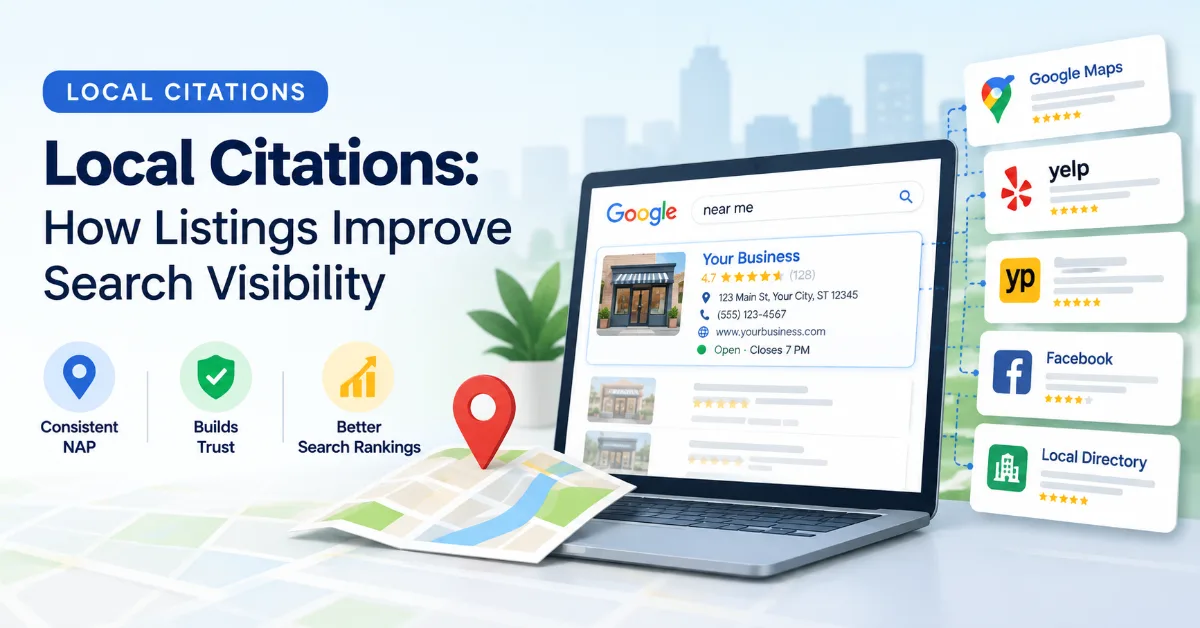
Local citations are one of the foundational elements of local SEO, but they are often misunderstood. Some businesses try to create as many directory listings as possible, while others assume citations no longer matter because Google can find business information directly from websites and Business Profiles.
The reality is more nuanced.
A well-managed citation profile can help search engines verify who a business is, where it operates, what it offers, and whether its information is trustworthy and consistent across the web. Citations can also create additional opportunities for customers to discover a business through directories, review platforms, industry websites, and local publications.
However, citation building is not a numbers game. A hundred inaccurate or irrelevant listings can be less useful than a smaller set of accurate, authoritative, industry-relevant citations.
This guide explains what local citations are, how they work, why NAP consistency matters, which citation types are valuable, common mistakes, and how an experienced local SEO campaign should approach citation building.
What Are Local Citations?
A local citation is an online mention of a business’s identifying information, usually including its:
- Business name
- Address
- Phone number
- Website URL
- Business category
- Hours
- Services
- Other business details
The most familiar examples are business directory and review-platform listings. Citations can also appear in local news articles, industry publications, chamber of commerce websites, community pages, sponsorship pages, and other relevant websites.
Citations are generally divided into two categories:
| Citation Type | Description | Example |
| Structured citation | Business information appears in a dedicated listing/profile | Yelp, industry directory, local business directory |
| Unstructured citation | Business is mentioned naturally within another webpage | Local news article, blog, sponsorship page |
This distinction matters because local SEO is no longer about simply submitting the same NAP information to hundreds of directories. Context, accuracy, relevance, and authority increasingly matter.
Why Do Local Citations Matter for SEO?
Search engines need reliable information to understand local businesses.
Google compiles business information from multiple sources, including business websites, third-party sources, user contributions, and business owners.
This creates an important SEO principle:
Your business information should tell the same story wherever customers and search engines encounter it.
For example, imagine a dental practice whose website says:
Smile Dental Care
125 Main Street
Raleigh, NC 27612
(919) 555-0145
But Yelp lists:
Smile Dental Center
125 Main St., Suite 2
(919) 555-0188
And another directory shows an old address.
The problem is not simply that customers may become confused. Multiple versions of the business information make the company’s digital presence less consistent.
That is why citation management is about much more than creating listings. It involves auditing, correcting, standardizing, and maintaining business information over time.
For businesses that need to strengthen the broader foundation around citations, Google Business Profile optimization should be considered alongside citation management.
Local Citations and Google’s Local Ranking System
Google states that local results are primarily influenced by relevance, distance, and prominence. Complete and accurate Business Profile information can help Google understand whether a business matches a local search. Google also notes that prominence can be influenced by factors such as links, reviews, and how well-known a business is.
Citations fit into this broader ecosystem.
They can help reinforce:
- Business identity
- Location
- Industry relevance
- Contact information
- Website relationships
- Local prominence
- Trust and consistency
But citations should never be treated as the only local ranking factor.
How the major local SEO signals work together
| Signal | What It Helps Establish | Example |
| Google Business Profile | Business identity and local relevance | Category, services, location |
| Local citations | Consistent business information | Yelp, directories, industry listings |
| Reviews | Reputation and customer experience | Google reviews |
| Website SEO | Relevance and topical authority | Service and location pages |
| Local links | Authority and local relationships | Chamber or community website |
| Behavioral signals | User interaction | Calls, clicks, direction requests |
| Proximity | Geographic relevance | Distance from searcher |
Businesses that want to understand the broader factors behind local visibility can also explore Local Ranker US’s local SEO services, which combine citation work with Google Business Profile optimization, local keyword research, on-page SEO, and local ranking strategies.
How Important Are Local Citations?
Current local SEO research shows that citations remain relevant, but their estimated influence varies depending on the search surface.
The 2026 Local Search Ranking Factors survey, based on practitioner assessments, places citation signals at approximately 6% of Local Pack/Maps ranking factors and 7% of local organic ranking factors. For AI search visibility, citation signals were assessed at approximately 13%.
These are expert survey estimates, not Google-published algorithm weights.
Citation influence by search surface
| Search Surface | Estimated Citation Signal Share | What It Means |
| Local Pack / Maps | 6% | Citations contribute, but GBP, reviews, proximity, and other signals also matter |
| Local Organic | 7% | Citations complement on-page SEO, links, and website authority |
| AI Search Visibility | 13% | Consistent third-party mentions can provide additional business context |
The practical takeaway is important:
Do not build a local SEO strategy around citation quantity alone.
Instead, use citations as part of a broader authority and consistency system.
The Most Important Types of Local Citations
Not every directory deserves the same amount of attention.
A professional citation strategy prioritizes platforms based on authority, relevance, geography, industry, and customer value.
1. Major Business Directories
These are broad platforms where businesses from many industries can establish listings.
Examples may include major business directories, mapping platforms, and established review sites.
For a local business, these listings can provide another place for customers to discover the company and verify basic information.
2. Industry-Specific Citations
Industry-specific directories can be particularly valuable because they provide contextual relevance.
For example:
Dentist:
Dental associations, healthcare directories, dental review platforms.
Law firm:
Legal directories, bar-related resources, legal publications.
Home services:
Contractor directories, home improvement platforms, trade organizations.
Restaurant:
Food directories, restaurant platforms, tourism websites.
The objective is not simply to obtain another backlink. It is to establish that the business belongs to a specific professional category.
3. Local and Geographic Citations
Local citations can come from websites connected to the business’s geographic market.
Examples include:
- Local chambers of commerce
- City business directories
- Local newspapers
- Community organizations
- Local business associations
- Regional publications
- Neighborhood websites
- Local event websites
A citation from a relevant local organization can provide useful geographic context.
4. Unstructured Citations
An unstructured citation does not necessarily look like a traditional directory listing.
For example, a local newspaper might publish:
“ABC Roofing recently completed a storm-damage restoration project in Dallas.”
The article may mention the business name, location, website, and services without using a standardized directory format.
These mentions can contribute to brand visibility, local authority, and entity recognition.
NAP Consistency: Why Name, Address, and Phone Matter
NAP stands for:
- Name
- Address
- Phone number
NAP consistency means your core business information is accurate and consistent across important online listings.
Consider this example:
| Platform | Business Name | Address | Phone |
| Website | ABC Plumbing | 100 Oak St | 555-1000 |
| ABC Plumbing | 100 Oak Street | 555-1000 | |
| Yelp | ABC Plumbing LLC | 100 Oak St | 555-1000 |
| Directory | ABC Plumbing | 102 Oak St | 555-1001 |
The last two listings create inconsistencies.
A citation audit should identify these differences and determine which information represents the legitimate current business details.
For businesses that need help correcting and building citations, NAP consistency and citation building are included within LocalRankerUS’s broader local SEO process.
Do You Need Hundreds of Local Citations?
No.
This is one of the biggest misconceptions in citation building.
An older BrightLocal study found that businesses ranking in position one for a local keyword had an average of 86 citations, compared with 75 citations for businesses ranking around position 10. However, the study explicitly cautions that correlation does not prove citations caused the higher rankings.
That distinction is critical.
A business ranking well may also have:
- A stronger Google Business Profile
- More reviews
- Better service pages
- More authoritative backlinks
- Greater brand recognition
- Better proximity
- Stronger customer engagement
Therefore, the question should not be:
“How many citations can we build?”
A better question is:
“Which citations strengthen this business’s local presence and make its information more accurate and trustworthy?”
Data: What Local Customers Actually Look At
Citation strategy also needs to consider the customer, not just search engines.
Recent local consumer research found that when researching local businesses, consumers consider factors such as proximity, star ratings, review volume, and listing completeness.
Local business research factors
| Customer Consideration | Percentage |
| Address / how nearby the business is | 44% |
| Star rating | 38% |
| Number of reviews | 37% |
| Complete listing information | 34% |
| Clear pricing or offer | 30% |
| Photos of business/work | 24% |
| Category or type of service | 24% |
This shows why citation optimization is not merely an SEO exercise.
A business listing can become a customer decision-making asset.
If someone searches for a plumber, dentist, attorney, HVAC company, or restaurant, an accurate listing can answer important questions before the person ever visits the website.
How to Build Local Citations Correctly
A professional citation campaign usually follows a structured process.
Step 1: Create a Master Business Data Sheet
Before submitting anything, document the approved business information.
Include:
- Official business name
- Address
- Phone number
- Website
- Primary category
- Secondary categories
- Business description
- Opening hours
- Service areas
- Social profiles
- Main services
This becomes the source of truth for citation submissions.
Step 2: Audit Existing Listings
Search for variations of:
Business Name + City
Business Name + Phone
Business Name + Address
Also check major directories manually and through citation-management tools.
Look for:
- Incorrect phone numbers
- Old addresses
- Duplicate listings
- Incorrect categories
- Wrong URLs
- Closed locations still appearing
- Inconsistent business names
- Missing listings
Step 3: Prioritize Citation Opportunities
Create a citation priority list instead of submitting everywhere.
| Priority | Citation Type | Example Goal |
| High | Major platforms | Establish core presence |
| High | Industry directories | Strengthen niche relevance |
| High | Local organizations | Strengthen geographic relevance |
| Medium | Review platforms | Improve discovery and trust |
| Medium | Community websites | Earn local mentions |
| Low | Generic directories | Use only when legitimate and relevant |
| Avoid | Spam directories | Do not build for volume |
Step 4: Standardize Business Information
Use the same approved business data wherever appropriate.
For example:
Correct:
ABC Dental
123 Main Street
Raleigh, NC 27612
(919) 555-1234
Avoid creating unnecessary variations such as:
- ABC Dental Clinic
- ABC Dental Raleigh
- ABC Dental – Best Dentist
- ABC Dental LLC Raleigh NC
Business names should reflect the real-world business name rather than being manipulated with keywords.
Local Citations vs. Local Links
A citation and a backlink are not exactly the same thing.
A citation primarily establishes or reinforces business information and identity.
A backlink is a clickable hyperlink from another website to your website.
A citation may include a link, but its value does not depend solely on whether the link passes traditional SEO authority.
For example:
A local chamber of commerce listing that accurately identifies a business and links to its website can provide both a citation and a relevant backlink.
A local newspaper article mentioning the business without linking to it can still function as an unstructured citation and brand mention.
This is why local SEO professionals should think beyond link counts.
For businesses that need to strengthen their broader authority profile, local link building should work alongside citation management rather than replace it.
Practical Example: Dental Practice Citation Strategy
Imagine a dental practice in Raleigh that has recently moved to a new office.
The website has been updated, but several old directories still show the previous address.
A professional citation cleanup would look like this:
Before
- Google: New address
- Website: New address
- Yelp: Old address
- Healthcare directory: Old address
- Local directory: New address
- Facebook: Old address
Action Plan
- Confirm the official address.
- Update the website.
- Verify Google Business Profile information.
- Correct major directory listings.
- Find duplicate profiles.
- Update healthcare-specific directories.
- Update local organization listings.
- Check map and navigation platforms.
- Document completed corrections.
- Recheck the listings periodically.
This is a much more useful citation strategy than simply creating 50 new directory profiles.
Common Local Citation Mistakes
Building Low-Quality Listings for Quantity
More listings do not automatically mean better rankings.
Creating profiles on irrelevant, low-quality directories can consume resources without providing meaningful visibility.
Using Keyword-Stuffed Business Names
Adding keywords to the business name can create guideline problems and inconsistent branding.
Use the legitimate business name.
Ignoring Duplicate Listings
Two profiles for the same business can create confusion for customers and search engines.
Duplicate management should be part of every citation audit.
Forgetting Old Locations
Businesses often move, change phone numbers, rebrand, or update websites.
Old information can remain online for years if nobody maintains it.
Treating Citations as a Standalone SEO Strategy
Citations cannot compensate for a weak website, poor reviews, an incomplete Google Business Profile, or a lack of relevant local authority.
Local Citations and AI Search Visibility
Local citations are becoming relevant beyond traditional Google rankings.
Recent local SEO research estimates that citation signals can contribute to AI search visibility, although these figures represent practitioner survey assessments rather than a published Google or AI-platform ranking formula.
This makes logical sense.
AI systems need information that helps establish:
- What the business is
- Where it operates
- What services it provides
- Whether it is legitimate
- How customers describe it
- Which third-party sources mention it
For businesses looking beyond traditional search, AI SEO for local businesses can complement citation and local SEO work by strengthening business/entity information across search experiences.
For that reason, modern citation work should include both structured listings and credible unstructured mentions.
A business that appears consistently across reputable local, industry, and community sources creates a stronger overall digital footprint.
Local Citation Checklist
Use this checklist when auditing a local business.
| Task | Status |
| Confirm official business name | ☐ |
| Confirm current address | ☐ |
| Confirm primary phone number | ☐ |
| Confirm website URL | ☐ |
| Audit Google Business Profile | ☐ |
| Find duplicate listings | ☐ |
| Check major directories | ☐ |
| Check industry-specific directories | ☐ |
| Check local directories | ☐ |
| Correct NAP inconsistencies | ☐ |
| Update old addresses | ☐ |
| Remove or resolve duplicate profiles | ☐ |
| Check business categories | ☐ |
| Review listing descriptions | ☐ |
| Check website links | ☐ |
| Monitor citation changes | ☐ |
| Track local rankings and leads | ☐ |
How LocalRankerUS Approaches Citation Building
At LocalRankerUS, citation building is treated as one layer of a broader local SEO system rather than a standalone link-building exercise.
Our local SEO services combine NAP consistency and citation building with Google Business Profile optimization, local keyword research, competitor analysis, local on-page SEO, and Map Pack strategy.
For example, if a local HVAC company wants to improve visibility for searches such as:
- HVAC repair near me
- AC repair in Dallas
- emergency HVAC service
- furnace repair near me
the strategy should not stop at directory submissions.
The campaign should also examine:
- Whether the Google Business Profile uses the correct categories.
- Whether the website has dedicated service pages.
- Whether the business information matches across important platforms.
- Whether the company has relevant local and industry citations.
- Whether reviews accurately reflect customer experiences.
- Whether local backlinks and mentions support the brand.
- Whether ranking improvements generate calls and qualified leads.
LocalRankerUS’s GBP optimization service also incorporates citation consistency alongside profile optimization, local keyword targeting, Maps ranking, and review management.
That broader approach is important because the goal of local SEO is not to collect directory profiles.
The goal is to build a trustworthy local presence that can be discovered, understood, and chosen by customers.
What Should Businesses Prioritize First?
If a business has limited time or budget, start with the fundamentals.
Priority 1: Accuracy
Make sure the core business information is correct.
Priority 2: Major Platforms
Establish and maintain profiles on important search, map, and review platforms.
Priority 3: Industry Relevance
Find directories and organizations specifically related to the business’s industry.
Priority 4: Local Relevance
Look for credible city, regional, chamber, community, and local publication opportunities.
Priority 5: Unstructured Mentions
Develop legitimate opportunities for the business to be mentioned by relevant websites.
Priority 6: Ongoing Monitoring
Citation work is not finished when submissions are completed.
Businesses move, rebrand, change phone numbers, launch new websites, and open additional locations. Citation management should therefore be treated as an ongoing SEO maintenance process.
Frequently Asked Questions About Local Citations
What are local citations in SEO?
Local citations are online mentions of a business’s identifying information, commonly including its name, address, and phone number. They can appear in structured business directories or as unstructured mentions within local news, blogs, industry websites, and community publications.
Are local citations still important for SEO?
Yes, but their role should be understood correctly. Current local SEO research continues to identify citation signals as part of local search visibility, while Google also considers relevance, distance, prominence, reviews, website information, and other signals. Citation building should therefore support a broader local SEO strategy rather than replace it.
How many local citations does a business need?
There is no universal number that guarantees rankings. The right quantity depends on the industry, location, competitors, and existing online presence. Businesses should prioritize accurate, authoritative, relevant citations instead of pursuing directory volume for its own sake.
What is NAP consistency?
NAP consistency means maintaining accurate and consistent business Name, Address, and Phone information across important online listings. If a business moves or changes its phone number, outdated listings should be identified and corrected.
Are local citations the same as backlinks?
No. A citation is primarily a business-information mention, while a backlink is a hyperlink from another website. A citation can contain a backlink, but a business can also receive valuable unlinked mentions through news articles, blogs, community websites, or other publications.
Are directory submissions enough to rank a local business?
No. Citations are only one component of local SEO. A competitive campaign may also require Google Business Profile optimization, relevant website content, reviews, local links, technical SEO, location relevance, and conversion optimization.
What are the best local citation sites?
The best citation sources depend on the business and market. Major platforms, industry-specific directories, reputable local organizations, and relevant community or professional websites are generally more useful than large numbers of unrelated directories.
Do citations help Google Maps rankings?
Citations can contribute to the broader local search ecosystem, but they do not guarantee a Google Maps ranking. Google says local results are mainly based on relevance, distance, and prominence, with many supporting signals involved.
Should service-area businesses build local citations?
Yes. Service-area businesses can benefit from accurate listings and relevant mentions, but they must follow platform guidelines regarding addresses and service areas. Citation strategy should focus on legitimate business information rather than creating artificial locations.
Final Thoughts: Local Citations Are About Trust, Not Volume
Local citations remain an important part of a well-rounded local SEO strategy, but their value has changed.
The objective is no longer simply to create as many listings as possible.
A stronger approach is to build a consistent, accurate, relevant, and authoritative digital footprint.
For a local business, that means making sure customers and search engines can repeatedly find the same core information across trustworthy sources.
The best citation strategy combines:
Accurate NAP + Relevant directories + Industry citations + Local mentions + Strong website + Google Business Profile + Reviews + Local authority
When these elements work together, citations become more than directory listings. They become part of the evidence that helps establish a real business’s identity, location, relevance, and reputation across the local search ecosystem.
Ready to Strengthen Your Local Search Visibility?
If your business has inconsistent listings, outdated NAP information, duplicate profiles, weak local visibility, or difficulty appearing in Google Maps, Local Ranker US can audit your current local presence and build a strategy around the signals that matter.
Our local SEO services combine citation building with Google Business Profile optimization, local keyword research, on-page SEO, local link building, competitor analysis, ranking tracking, and ongoing optimization.
Start with a Free Business Growth Audit and identify the local SEO issues that may be limiting your visibility.
These links keep the article’s internal-link profile topically relevant and conversion-oriented without over-optimizing the same anchor text repeatedly. The Local Ranker US local SEO page specifically confirms that its service includes NAP consistency, citation building, GBP optimization, local on-page SEO, and Map Pack work.