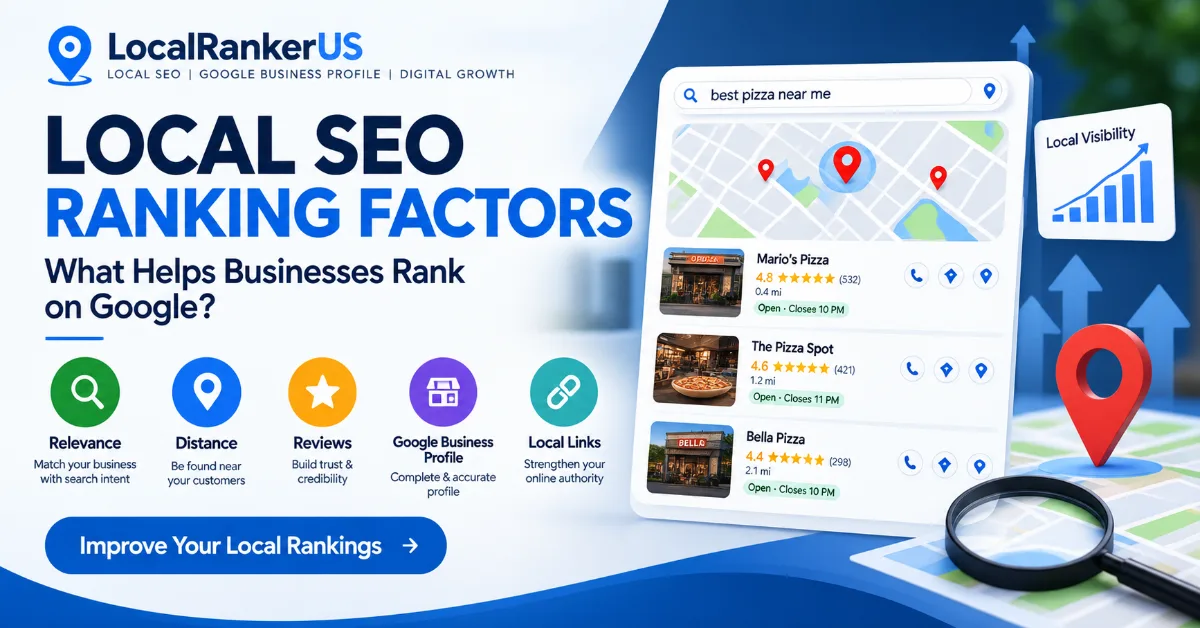
Ranking a local business on Google is not about adding a city name to a website and waiting for the phone to ring.
Local search visibility is influenced by several connected signals: how well a business matches the search, how close it is to the searcher, how established and trusted it appears, how useful its website is, and how consistently its business information appears across the web.
Google itself says local results are primarily based on relevance, distance, and prominence. Google also explains that prominence can be influenced by information such as links, reviews, and other online references to a business. (Google Help)
For businesses competing in crowded markets, the practical challenge is turning those broad principles into an actionable SEO strategy.
This guide breaks down the most important local SEO ranking factors, explains how they work together, and shows what businesses can actually do to improve local visibility.
What Are Local SEO Ranking Factors?
Local SEO ranking factors are the signals Google uses to determine which businesses and webpages should appear for location-based searches.
These signals can affect different parts of Google’s local search ecosystem, including:
- Google Maps
- Local Pack results
- Google Business Profile visibility
- Local organic search results
- Location-based service searches
- “Near me” searches
- Service + city searches
- Branded local searches
For example, a person searching for “emergency dentist near me” is not simply looking for a webpage containing those words.
Google needs to understand:
- What the business does
- Where it operates
- Whether it is relevant to emergency dental care
- How close it is to the searcher
- How established and trusted it appears
- Whether its website and business information support the same entity
That is why effective local SEO requires more than keyword optimization.
The Three Core Local Ranking Factors According to Google
Google officially groups local ranking around three major concepts:
| Core Factor | What It Means | Practical SEO Focus |
| Relevance | How closely the business matches the search | Categories, services, website content, profile completeness |
| Distance | How close the business is to the searcher or specified location | Accurate address, service area, location targeting |
| Prominence | How well-known and established the business is | Reviews, links, mentions, reputation, authority |
Google states that local results are primarily based on these three factors. It also notes that more reviews and positive ratings can help local ranking, while information from websites, links, articles, and directories can contribute to prominence. (Google Help)
This is an important distinction for business owners:
There is no single “local SEO ranking factor” that guarantees a top position.
A strong local presence is built by improving multiple connected signals.
Local SEO Ranking Factors: What Matters Most?
A recent local search ranking-factor survey, summarized by BrightLocal, grouped expert opinions into major signal categories.
For Local Pack/Maps rankings, the reported distribution was:
| Ranking Factor Group | Expert-Estimated Share |
| Google Business Profile | 32% |
| Reviews | 20% |
| On-Page | 15% |
| Behavioral | 9% |
| Links | 8% |
| Citations | 6% |
| Personalization | 6% |
| Social | 4% |
For local organic rankings, the survey reported:
| Ranking Factor Group | Expert-Estimated Share |
| On-Page | 33% |
| Links | 24% |
| Behavioral | 10% |
| Personalization | 8% |
| Google Business Profile | 7% |
| Citations | 7% |
| Reviews | 6% |
| Social | 5% |
These percentages are not Google’s official algorithm weights. They represent expert opinions from a local-search ranking-factor study and should be used to prioritize SEO work rather than treated as a mathematical ranking formula. (BrightLocal)
The difference between the two tables is particularly useful.
Google Maps/Local Pack: GBP and reviews receive more emphasis in the expert survey.
Local organic results: On-page SEO and links receive more emphasis.
That means businesses trying to win local search should optimize both the Business Profile and the website.
1. Google Business Profile Optimization
For businesses that depend on Google Maps, the Google Business Profile is one of the most important areas to get right.
Google recommends keeping Business Profile information complete and accurate, including business details, hours, categories, attributes, photos, and other relevant information. (Google Help)
Important GBP optimization elements include:
- Accurate business name
- Correct primary category
- Relevant secondary categories
- Complete business information
- Accurate address
- Correct service area
- Business hours
- Phone number
- Website
- Services
- Products where applicable
- Attributes
- High-quality photos
- Genuine customer reviews
Practical example
Suppose a family dentist in Chicago has selected “Dentist” as its primary category but offers emergency dental care, implants, cosmetic dentistry, and pediatric services.
A useful optimization process would make sure the profile accurately communicates these services without keyword stuffing or manipulating the business name.
This gives Google more legitimate information to understand the business.
For businesses that need a structured GBP strategy, [Local Ranker US’s GBP Optimization service] offers profile optimization, category and attribute setup, service optimization, Google Maps ranking work, and review management. (Local Ranker US)
2. Relevance and Search Intent
Relevance is one of Google’s three officially stated local ranking concepts.
The question is simple:
Does this business actually match what the person is searching for?
Consider these searches:
- “dentist near me”
- “emergency dentist in Raleigh”
- “teeth whitening Raleigh”
- “dental implants near me”
A dental practice may be relevant to the first search but not necessarily the strongest result for every specialized query.
This is where local keyword research becomes important.
Instead of creating one page targeting every keyword, businesses should map search intent to appropriate pages.
| Search Intent | Recommended Page |
| Dentist near me | Main dental/location page |
| Emergency dentist | Emergency dentistry service page |
| Dental implants | Dental implants service page |
| Teeth whitening | Teeth whitening service page |
| Dentist in Raleigh | Raleigh location/service page |
| Cost of dental implants | Cost/educational content |
The objective is not to repeat keywords.
The objective is to create the most useful page for the searcher’s actual need.
3. Local On-Page SEO
On-page SEO is particularly important for local organic rankings.
The expert survey summarized by BrightLocal identified on-page factors as the largest category for local organic rankings at 33%. (BrightLocal)
A strong local page should clearly communicate:
- What service is offered
- Who the service is for
- Where the service is available
- Why the business is qualified
- What customers can expect
- How to contact or book the business
Important on-page elements include:
Title Tag
Include the primary topic and location naturally where appropriate.
H1
Clearly describe the page’s primary subject.
Service Content
Explain the service in enough depth to satisfy the user’s intent.
Location Signals
Use legitimate location references where they make sense.
Internal Links
Connect related services, locations, educational articles, and conversion pages.
Google’s documentation also recommends crawlable internal links and explains that descriptive anchor text can help both users and Google understand linked pages. (Google for Developers)
4. Dedicated Service Pages
One of the most practical local SEO improvements is creating useful dedicated pages for important services.
Imagine an HVAC company offering:
- AC repair
- AC installation
- Furnace repair
- Heat pump installation
- Duct cleaning
Putting all five services into one short page makes it harder to satisfy highly specific searches.
Instead, each major service can have its own useful page.
For example:
/ac-repair/
could explain:
- Common AC problems
- When to call a technician
- Repair process
- Service area
- Pricing considerations
- FAQs
- Credentials
- Customer evidence
- Booking options
This approach aligns the page more closely with the searcher’s intent.
BrightLocal’s 2025 summary of local ranking-factor research identified dedicated service pages and geographic relevance among the leading factors for local organic rankings. (BrightLocal)
5. Reviews and Reputation
Reviews are important for two separate reasons:
- They can contribute to local search visibility.
- They strongly influence customer decisions.
Google explicitly states that review count and positive ratings can help a business’s local ranking. (Google Help)
Consumer behavior research reinforces the importance of reviews.
BrightLocal’s 2025 Local Consumer Review Survey found that 97% of consumers read online reviews when researching local businesses, while 81% used Google to find reviews. The study surveyed 1,026 US adults. (BrightLocal)
Another finding is especially useful for local businesses: 96% of consumers surveyed were open to writing a business review. (BrightLocal)
That creates a practical opportunity.
Instead of simply asking every customer, “Can you leave us a five-star review?”, businesses should create an easy process for genuine customers to share their experience honestly.
Better review strategy
Ask appropriate customers for feedback after a completed service.
Make the process simple.
Respond professionally to positive and negative feedback.
Never buy reviews or create fake customer experiences.
6. Local Citations and NAP Consistency
Citations are online references to a business’s basic information, commonly including:
- Name
- Address
- Phone number
This is often called NAP consistency.
Relevant citations can help reinforce business identity and location information across the web.
However, citation building should not become a numbers game.
A business does not necessarily need hundreds of low-quality directory listings.
A better strategy is to prioritize:
- Major business directories
- Industry-specific directories
- Local organizations
- Chamber of commerce listings
- Relevant professional associations
- Trusted local websites
Google says it compiles Business Profile information from multiple sources, including public web content, third-party data, users, and business owners. (Google Help)
That makes consistent business information a sensible part of local SEO maintenance.
7. Local Link Building
Links remain important, particularly for local organic rankings.
The local ranking-factor survey summarized by BrightLocal placed links at 24% of the estimated local organic ranking-factor mix. Again, this is expert survey data—not an official Google percentage. (BrightLocal)
For local businesses, useful links often come from real relationships.
Examples include:
- Local news websites
- Industry organizations
- Chamber of commerce
- Community organizations
- Local sponsorships
- Business partners
- Supplier websites
- Professional associations
- Local events
Practical example
A local dental office sponsors a community health event.
The organization publishes an event page listing sponsors and links to the dental practice’s website.
That is more meaningful than purchasing hundreds of unrelated links from generic websites.
The objective should be relevance, credibility, and real-world connection.
Google also warns that unnatural link schemes can violate its spam policies. (Google for Developers)
8. Location and Proximity
Distance is one of Google’s three core local ranking concepts.
A business cannot simply optimize its way out of every geographic limitation.
For example, suppose three plumbers are competing for:
“plumber near me”
If one business is several miles closer to the searcher, another has more reviews, and another has stronger website relevance, the final ordering can vary depending on the search context.
This is why local rankings are not static.
Your business may rank:
#2 at one location
and
#9 a few miles away.
That is completely different from traditional organic rankings.
Businesses should therefore use tools such as local rank grids or geo-based tracking instead of relying only on manual searches from one office.
9. Website Authority and Organic SEO
Google’s local search system does not operate independently of traditional search.
Google states that prominence can incorporate information from across the web, including links and articles, and that a business’s position in web results can also play a role. (Google Help)
That means local businesses should not treat their website as merely an online brochure.
The website should establish:
- Expertise
- Relevant services
- Location relevance
- Trust
- Authority
- Useful information
- Clear conversion paths
This is particularly important for competitive industries such as:
- Dentists
- Personal injury attorneys
- HVAC companies
- Plumbers
- Roofers
- Real estate companies
- Med spas
- Home remodeling companies
10. Behavioral and Conversion Signals
Behavioral signals are frequently discussed in local SEO, but they should be handled carefully.
There is no legitimate strategy of simply generating fake clicks to “trick Google.”
Instead, businesses should improve the real customer experience.
Ask:
- Can visitors quickly find the phone number?
- Is the service page useful?
- Is the address easy to verify?
- Are booking options obvious?
- Does the website load properly on mobile?
- Can customers understand pricing or next steps?
- Does the GBP accurately reflect the website?
Google’s broader Search guidance emphasizes useful, reliable, people-first content rather than content created primarily to manipulate rankings. (Google for Developers)
11. Business Information Consistency
Google uses information from multiple sources to understand local businesses.
That means inconsistencies can create unnecessary confusion.
For example:
| Source | Business Name | Phone |
| Website | ABC Roofing LLC | 555-100-2000 |
| Google Business Profile | ABC Roofing | 555-100-2000 |
| Directory A | ABC Roofing LLC | 555-100-2000 |
| Directory B | ABC Roofing Services | 555-999-8888 |
This does not automatically mean the business will be penalized.
But it is a clear reason to perform a local entity and citation audit.
The goal is to make the business easier for search engines and customers to identify correctly.
12. Photos, Videos, and Profile Activity
Google recommends adding photos and videos to Business Profiles because they help businesses show customers what they offer and tell the story of the business. (Google Help)
For example, a dental practice can showcase:
- Reception area
- Treatment rooms
- Team members
- Technology
- Exterior signage
- Before-and-after examples where appropriate
- Educational videos
These assets primarily support customer confidence and profile completeness.
They should not be treated as a magic ranking shortcut.
The same principle applies to Google Business Profile Posts.
Posting consistently can help keep customers informed, but businesses should not assume that posting frequency alone guarantees higher Maps rankings.
A Practical Local SEO Ranking Factor Checklist
| Area | What to Check | Priority |
| Google Business Profile | Categories, services, details, hours | Critical |
| Relevance | Search intent and service alignment | Critical |
| Website | Service/location pages | Critical |
| Reviews | Authentic reviews and responses | High |
| NAP | Consistent business information | High |
| Local links | Relevant authority-building links | High |
| Citations | Important directories and industry sources | Medium–High |
| Location | Accurate address/service area | Critical |
| Content | Helpful local and service content | High |
| Internal links | Connected service and location pages | Medium–High |
| Photos | Real business images | Medium |
| Conversion | Calls, forms, bookings | High |
| Tracking | Rankings, calls, leads, GBP actions | Critical |
How Local Ranker US Uses These Ranking Factors
At Local Ranker US, local SEO is approached as a connected system rather than a single optimization task.
The Local SEO & GBP Ranking service combines areas such as:
- Google Business Profile optimization
- Local keyword research
- Competitor analysis
- NAP consistency
- Citation building
- Local on-page SEO
- Service and location optimization
- Google Maps ranking
- GBP posts and updates
- Performance reporting
The company describes its process around audit and strategy, optimization and fixes, ranking and growth, and ongoing reporting. (Local Ranker US)
This matters because local businesses rarely have only one problem.
A dentist might have a well-optimized GBP but weak service pages.
A plumber might have strong website content but inconsistent citations.
A law firm might have excellent reviews but poor location targeting.
A restaurant might have strong Maps visibility but a website that does not convert visitors into reservations.
Local SEO works best when these pieces are evaluated together.
What Local Businesses Should Prioritize First
Not every business needs to work on every ranking factor simultaneously.
A practical priority sequence is:
Phase 1: Fix the Foundation
- Verify the Google Business Profile
- Correct business information
- Select accurate categories
- Fix address/service-area issues
- Resolve duplicate listings
- Audit the website
Phase 2: Improve Relevance
- Research local keywords
- Build important service pages
- Create useful location content
- Improve titles and headings
- Strengthen internal linking
Phase 3: Build Trust
- Generate authentic reviews
- Respond to customer feedback
- Improve business information
- Add real photos
- Strengthen local reputation
Phase 4: Build Authority
- Earn relevant local links
- Build industry citations
- Develop partnerships
- Publish useful local resources
- Gain legitimate local mentions
Phase 5: Measure and Improve
Track:
- Local keyword rankings
- Map Pack visibility
- GBP searches
- GBP calls
- Website traffic
- Form submissions
- Booking requests
- Qualified leads
- Revenue where attribution is possible
Google’s Business Profile performance reporting includes searches, views, and customer interactions, allowing verified businesses to monitor how people discover and interact with their profiles.
Frequently Asked Questions
What are the most important local SEO ranking factors?
Google officially identifies relevance, distance, and prominence as the primary concepts behind local rankings. In practical SEO work, these translate into Business Profile optimization, accurate location information, relevant website content, reviews, links, citations, and overall business prominence.
Does Google Business Profile help local SEO?
Yes. Google recommends using and maintaining a Business Profile to improve local visibility, and complete and accurate information can help businesses appear for relevant local searches.
Do Google reviews affect local rankings?
Google states that review count and positive ratings can help a business’s local ranking. Reviews also strongly influence customers: BrightLocal’s 2025 survey found that 97% of US consumers read online reviews when researching local businesses. (Google Help)
How important are citations for local SEO?
Citations can help reinforce business information and entity consistency, but quality and relevance matter more than simply accumulating large numbers of directory listings. Google uses information from multiple sources across the web when compiling Business Profile information. (Google Help)
Do backlinks help local SEO?
Yes, links remain an important part of local organic SEO. Expert survey data summarized by BrightLocal placed link signals at 24% of the estimated local organic ranking-factor mix. This is survey-based industry research rather than a Google-published percentage. (BrightLocal)
Does proximity affect Google Maps rankings?
Yes. Google identifies distance as one of the three primary factors in local search. The distance between the searcher and a business can therefore influence which businesses appear for location-based searches. (Google Help)
How long does local SEO take to work?
There is no universal timeline. Results depend on competition, business history, website quality, geographic market, authority, current rankings, and the amount of work required. Local SEO should be evaluated using trend data rather than expecting an immediate ranking change after a single optimization.
Should I create separate pages for every city I serve?
Only when those pages provide genuine value. Creating near-identical city pages with only the location name changed can create poor-quality content. A useful location page should contain meaningful information about the service, location, customer needs, business presence, and local context.
Are Google Business Profile Posts a ranking factor?
Google does not identify GBP Posts as one of its three primary local ranking factors. Posts can support customer communication and engagement, but businesses should not treat posting frequency as a guaranteed Maps-ranking tactic. (Google Help)
Should local businesses focus on Google Maps or organic SEO?
Most businesses benefit from both. Google Maps visibility is particularly important for local-intent searches, while organic results can capture service, informational, comparison, and location-specific searches. The strongest strategy connects the Business Profile with a useful, authoritative website.
Final Thoughts
The most effective way to understand local SEO ranking factors is to stop looking for one secret ranking signal.
Google’s own framework is straightforward: relevance, distance, and prominence.
The professional SEO work happens underneath those concepts.
Relevance comes from accurate Business Profile information, appropriate categories, strong service pages, useful content, and clear search-intent alignment.
Distance comes from the business’s legitimate location and service area.
Prominence is strengthened through genuine reviews, relevant links, business mentions, citations, reputation, and a strong overall web presence.
The latest industry research reinforces this broader view. Expert survey data indicates that Google Business Profile signals and reviews are particularly important for Local Pack rankings, while on-page and link signals carry greater estimated weight for local organic rankings. (BrightLocal)
At the same time, customer behavior shows why reputation matters beyond rankings: 97% of US consumers surveyed by BrightLocal in 2025 said they read online reviews when researching local businesses, while 96% were open to writing a review. (BrightLocal)
For a local business, the goal should therefore be bigger than simply reaching position #1.
The goal is to become the business Google can confidently understand, the customer can easily find, and the customer has enough evidence to trust.
Ready to Improve Your Local Search Visibility?
If your business is struggling to appear in Google Maps, the Local Pack, or local organic results, Local Ranker US can audit the major local SEO signals affecting your visibility.
From Local SEO and Google Business Profile optimization to local keyword research, citations, on-page SEO, reputation management, and Google Maps ranking, the focus is on building a stronger local search foundation and connecting visibility to real business leads.
Get a Free Business Growth Audit from Local Ranker US and identify the local SEO opportunities holding your business back.